
Pests
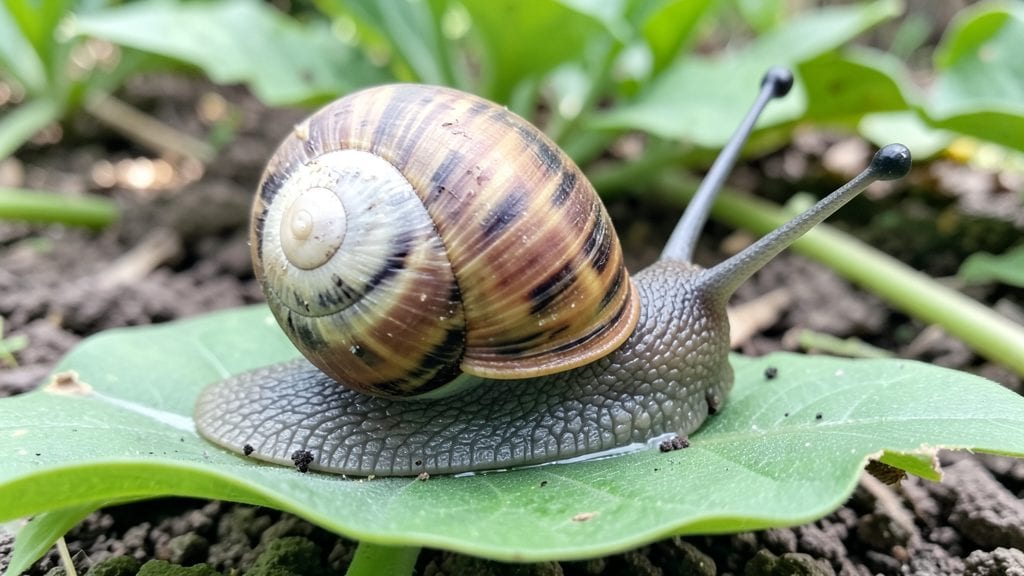
Understanding garden snail anatomy reveals a spiral shell for protection, a muscular foot that secretes mucus for smooth movement, and two retractable tentacles with eyes at their tips. Their soft body houses a specialized radula for scraping plant surfaces, a lung for breathing air, and a digestive system perfectly adapted to break down fibrous greens.
These tiny creatures might seem simple, but their body design is a masterpiece of efficiency. 🌿 The radula alone is fascinating—it's like a built-in rasp that can grind through tough plant cell walls, making them formidable garden pests.
Their mucus trail isn't just for gliding; it contains antimicrobial properties that protect against bacteria while they traverse moist surfaces. What's especially clever is how their lung system allows them to thrive in both damp soil and above-ground environments, giving them incredible adaptability in garden settings.
What makes snail anatomy particularly interesting is how each feature works together for survival. The spiral shell isn't just for protection—its shape helps regulate moisture levels, while the muscular foot provides both locomotion and a temporary anchor when feeding.
Their eyes, perched on those retractable tentacles, give them a 360-degree view of potential predators or food sources. This combination of adaptations explains why they're so successful in gardens worldwide.
💡 In This Article
- How Garden Snail Body Parts Work Together
- Identifying Snail Shell and Foot Features for Garden Control
How garden snail body parts work together
The garden snail's muscular foot is its primary mode of transportation, secreting a trail of mucus that acts as both lubricant and protective barrier. This mucus contains glycoproteins that harden slightly upon contact with air, creating a slippery yet sturdy path.
The foot's sole contains 10,000-20,000 tiny cilia that work like microscopic conveyor belts, propelling the snail forward at speeds up to 0.03 mph—slow but efficient for their nocturnal lifestyle. This system allows them to traverse uneven garden surfaces while maintaining a moisture barrier against dehydration.
The radula, a ribbon-like structure in their mouth, contains 100-200 rows of tiny teeth that can scrape through plant cell walls with remarkable precision. Each tooth is made of chitin and iron, forming a rasp that can grind through tough plant fibers like lettuce or tomato leaves.
What's fascinating is how they replace worn teeth continuously—some species regenerate up to 10,000 teeth in their lifetime. This feeding adaptation explains why they can devour entire seedlings overnight, making them such effective garden pests.
Their retractable tentacles serve as a dual-purpose sensory system, with the upper pair containing eyes at the tips that can detect movement up to 3 feet away. These eyes lack eyelids but are protected by a clear, gel-like covering.
The lower tentacles act as chemoreceptors, sampling air currents for food or predators. When threatened, snails retract everything into their shell within 0.5 seconds, a reflex controlled by their cerebral ganglia—a primitive brain that processes sensory input with remarkable speed for their size.
Breathing occurs through a specialized pneumostome, a small opening near the base of their body that connects to their single lung. Unlike mammals, snails can't breathe continuously—they must keep the pneumostome moist to prevent drying.
This explains why you'll often find them in damp areas or under vegetation. Their heart rate drops to just 1-2 beats per minute when dormant, conserving energy while still maintaining basic metabolic functions.
The spiral shell isn't just armor—its coiled structure creates microclimates that regulate humidity and temperature. The shell's calcium carbonate composition makes it both lightweight and strong, with a density similar to concrete.
Interestingly, the shell's growth pattern forms a counterclockwise spiral (when viewed from above), which helps prevent predators from easily prying them out. This architectural marvel also serves as a portable home, carrying their entire body weight while providing protection from birds, beetles, and other predators.
What makes this anatomy truly remarkable is how these systems integrate during feeding. When a snail encounters a leaf, its foot anchors securely while the radula begins scraping. The mucus trail doubles as a temporary food storage—enzymes in the mucus begin breaking down plant fibers even before ingestion.
Meanwhile, the tentacles continuously monitor for threats, and the pneumostome adjusts breathing rate based on activity level. This coordinated system explains why garden snails can thrive in environments where other herbivores would struggle.