
Landscaping
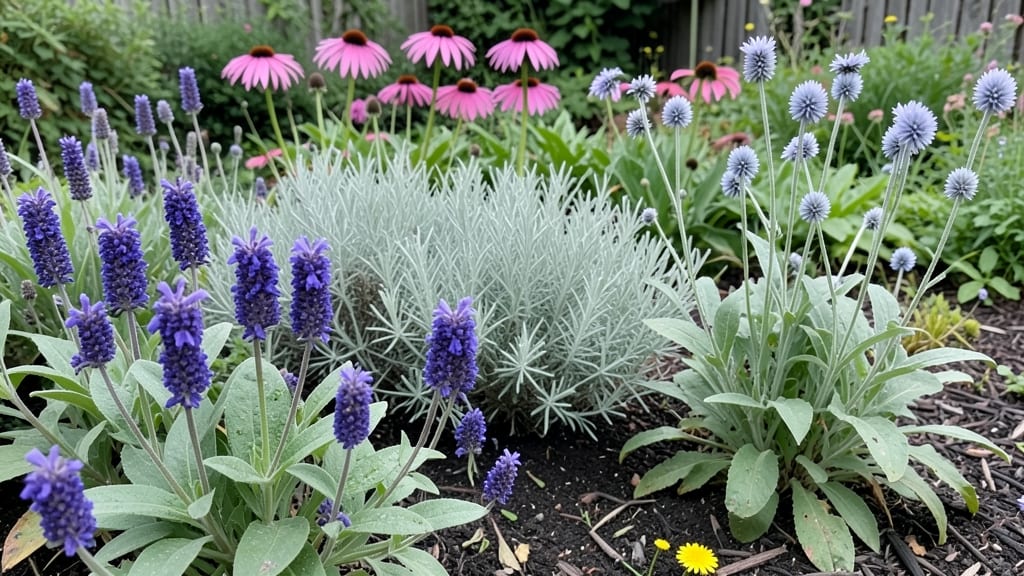
Determining the area of a garden lets you plan layouts efficiently by multiplying length by width for rectangular spaces or using πr² for circular designs, then converting to square feet. For oddly shaped gardens, break them into smaller sections and calculate each part separately.
Understanding your garden's square footage is the foundation for everything from plant spacing to material purchases. 🌱 A precise measurement ensures you buy just enough mulch, soil, or pavers without overpaying for extras.
For example, a 10-foot by 12-foot rectangular plot equals 120 square feet, while a circular raised bed with a 6-foot diameter covers about 28 square feet. Even small errors can throw off your entire design—like planting too close together or running out of edging stones mid-project.
For irregular shapes, think of your garden as a puzzle. Divide it into triangles, trapezoids, or rectangles, then add up each piece's area. This method works especially well for sloped yards or curved borders.
Pro tip: sketch your garden layout first—it helps visualize where to draw imaginary lines for calculations. Accuracy here saves time (and money) later when you're ordering supplies or arranging plants.
💡 In This Article
- Garden Space Measurement Formulas Explained
- Practical Tools for Measuring Garden Dimensions
Garden space measurement formulas explained
Here's what's actually happening when you measure garden space: every formula you use is essentially breaking down three-dimensional space into two-dimensional calculations. For rectangular plots, the simple length × width formula works because you're projecting the garden's surface area onto a flat plane.
Think of it like unfolding a box—you're measuring the footprint, not the depth. The key factor is that all measurements must be in the same unit (feet or meters) to avoid errors, since mixing inches with yards would give you nonsensical results.
Circular garden beds use πr² because they're essentially perfect circles, and π (pi) represents the constant ratio of a circle's circumference to its diameter. For example, a 5-foot diameter circular bed has a radius of 2.5 feet, so its area equals 3.14 × (2.5)² = 19.63 square feet.
This formula becomes especially useful for raised beds or pond edges where straight measurements are impractical. Triangular sections (like those in kidney-shaped gardens) use ½ × base × height, which accounts for their sloped sides by treating them as half of a rectangle.
What most people don't realize is how diagonal measurements affect accuracy. A garden that appears rectangular might have subtle angles from uneven ground or curved borders.
To handle this, measure both the horizontal and vertical dimensions separately, then use the Pythagorean theorem (a² + b² = c²) to calculate the true diagonal length.
For instance, a 10-foot by 12-foot plot with a 4-foot diagonal discrepancy might actually measure 124 square feet instead of 120 square feet—a 3.3% difference that adds up when buying materials.
Irregular borders create the biggest challenges because they defy simple formulas. The solution is to divide the space into geometric shapes you can calculate individually. For example, a garden with a curved front edge could be split into a rectangle (main body) plus a semicircle (front border).
Each section's area is calculated separately, then summed for the total. This method works because any irregular shape can be approximated by combining basic geometries—like how complex landscapes are built from simple forms in design software.
Precision matters because planting spacing and material estimates rely on accurate square footage.
For instance, most vegetables need 1 square foot of space per plant, so a 200-square-foot garden could support 200 tomato plants—but if your measurement was off by 10%, you'd either be short on plants or overcrowded.
Similarly, mulch bags are sold by the cubic foot, but coverage rates assume 2-3 inches of depth. A 100-square-foot bed at 3 inches deep requires 21 cubic feet of mulch—not 100 cubic feet—a common miscalculation that leads to wasted money.
Pro tip: Always measure the longest and shortest points of any dimension, then average them for a more accurate middle value. For example, if one side measures 8 feet at the top and 7 feet at the bottom, use 7.5 feet in your calculations.
This accounts for slopes and uneven terrain without requiring complex trigonometry. The small extra effort here prevents costly mistakes when ordering supplies or designing layouts.